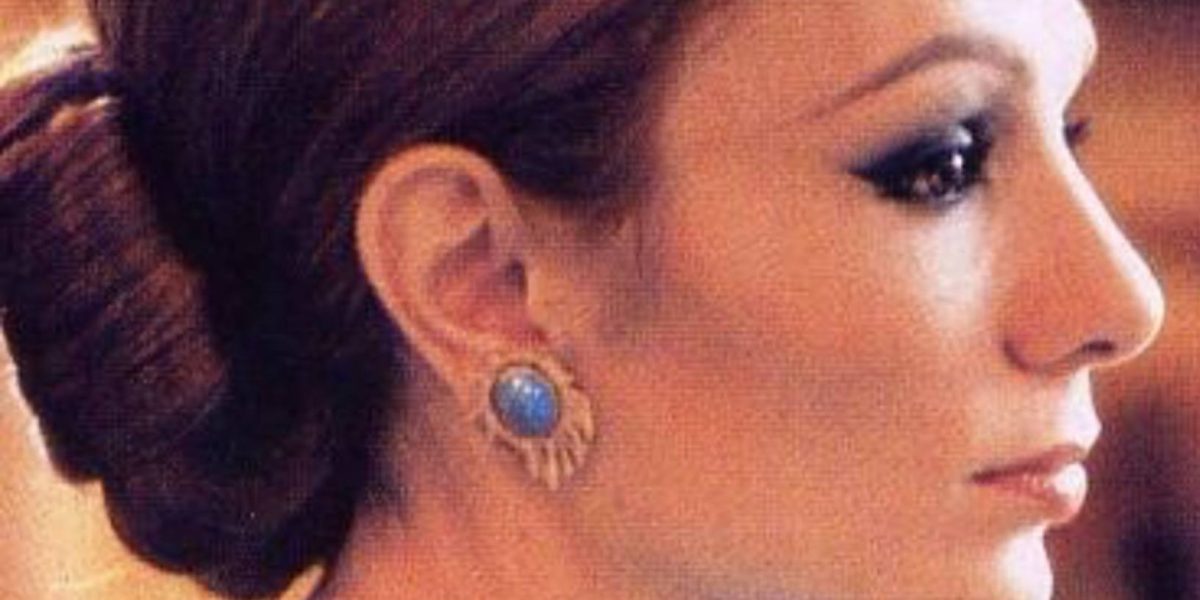
A Stone That Began With Belief
Few gemstones entered human history through belief rather than beauty. Turquoise is one of them.
Long before it appeared in jewelry boxes or fashion collections, turquoise was embedded into objects of protection. Warriors carried it into battle, rulers placed it within ceremonial objects, and temples preserved it as a symbol of divine balance.
In ancient Persia, turquoise was believed to be a fragment of the sky fallen onto the earth. Its blue surface carried cosmological meaning: heaven meeting land. Because of this symbolism, the stone was thought to guard against misfortune and sudden death. Soldiers mounted turquoise into sword hilts and armor. Rings containing turquoise were worn as protective seals, trusted to warn their owner of danger by fading or cracking.
Wearing turquoise was not ornamental. It was deliberate.
In Egypt, the stone carried another layer of meaning. Turquoise was sacred to the goddess Hathor, a deity associated with love, joy, fertility, and music. As protector of women and children, Hathor was symbolically linked to turquoise jewelry and ceremonial objects. The stone was believed to invite harmony, emotional balance, and prosperity.
Across civilizations, turquoise held a rare duality: celestial yet earthly, gentle yet protective. Unlike diamonds or rubies, it did not represent conquest or domination. Its symbolism rested in guardianship.
Centuries later, turquoise would acquire a new cultural meaning. During the early twentieth century, artists of the Arts and Crafts movement embraced its irregular surface and matte color as a rejection of industrial excess. In contrast to the sharp brilliance of diamonds, turquoise represented the handmade, the organic, and the human.
What keeps turquoise alive today is not sparkle.
It is emotional proximity.
Even when newly cut, turquoise appears lived-in. When inherited, it feels immediately personal.
The Geological Identity of Turquoise
Turquoise is among the oldest gemstones known to humanity, with archaeological evidence tracing its use to nearly 5000 BCE in Mesopotamia.
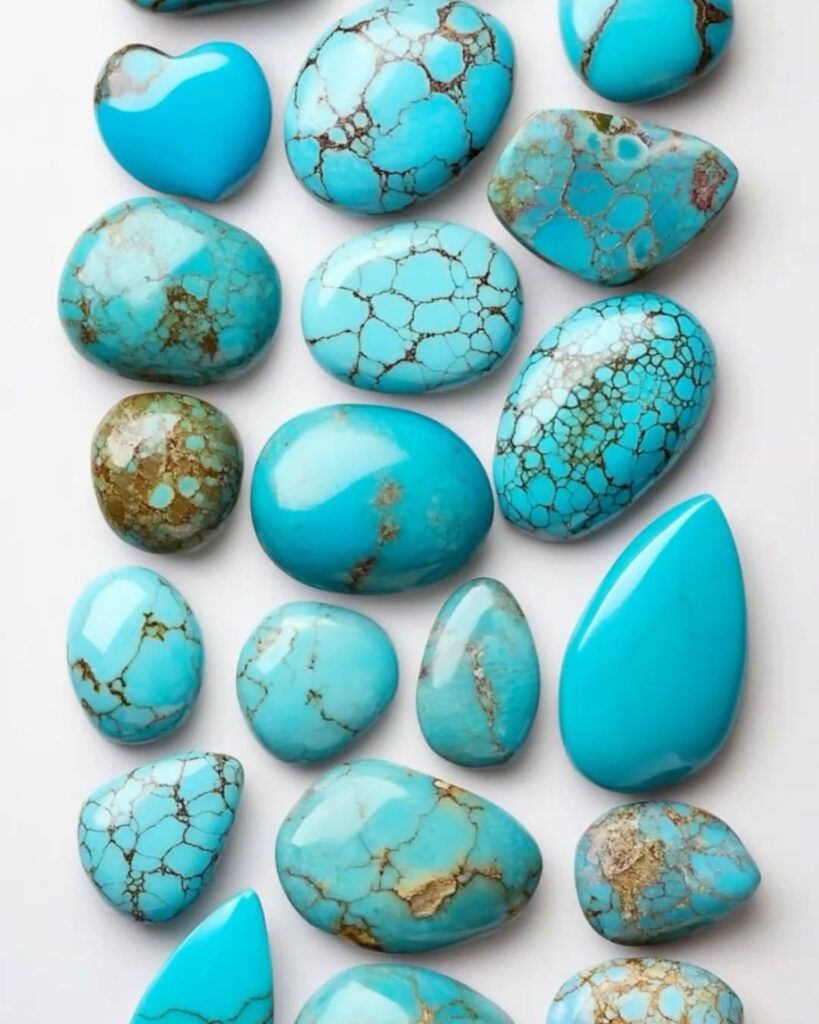
Geologically, turquoise is a hydrated copper aluminum phosphate mineral. Its color varies depending on mineral composition: copper produces vibrant blue tones, while iron shifts the stone toward green.
Unlike transparent gemstones, turquoise is opaque. For this reason, it has historically been shaped into beads, amulets, and smooth cabochons rather than faceted gems. The cabochon cut respects the stone’s depth and surface character rather than forcing brilliance.
Another defining characteristic of turquoise is its porosity. The stone absorbs oils, moisture, and the natural chemistry of its wearer’s skin. Over time its color may deepen or subtly change. In the world of turquoise, this transformation is not considered damage. It is evidence of life lived with the stone.
Among all varieties, Persian turquoise remains the most historically revered.
Persian Turquoise and the Legacy of Nishapur
For centuries, the mines of Nishapur in northeastern Iran produced what many gem historians still consider the finest turquoise in the world.
Persian turquoise is prized for its dense composition and its clear sky-blue color. Unlike many other turquoise varieties, it rarely shifts toward green. This stable blue shade became the global reference for what turquoise should look like.
The stone’s importance extended far beyond jewelry. Persian turquoise decorated royal architecture, ceremonial vessels, weapons, and thrones. In these contexts, it symbolized legitimacy and protection.
The blue domes of Persian architecture echo the same celestial symbolism. In both architecture and jewelry, turquoise created a visual bridge between earthly authority and heavenly order.
Because turquoise is relatively soft, modern stones are often stabilized using wax or resin to improve durability. When disclosed, such treatments are widely accepted in the gemstone trade. Authentic turquoise, however, remains identifiable through its natural veining, subtle variation, and warm, organic surface.
Turquoise was never about perfection.
It was about authenticity.
The Woman Who Wears Turquoise
In contemporary fashion, turquoise resonates with women whose authority is already established.
Historically worn by warriors and rulers, turquoise functioned as protection and identity rather than decoration. Today it continues to signal independence and creative control.
Women who wear turquoise often choose it intentionally. The stone carries personality. It is rarely used in excess.
Public figures who incorporate turquoise tend to do so with visual discipline.
Priyanka Chopra has worn turquoise rings and earrings as controlled accents alongside structured tailoring.
Beyoncé favors bold turquoise statement pieces whose scale reinforces her commanding stage presence.
Angelina Jolie has often chosen turquoise for its cultural resonance and historical depth.
Turquoise does not amplify attention through sparkle. It anchors attention through color and presence.
Styling Turquoise With Authority
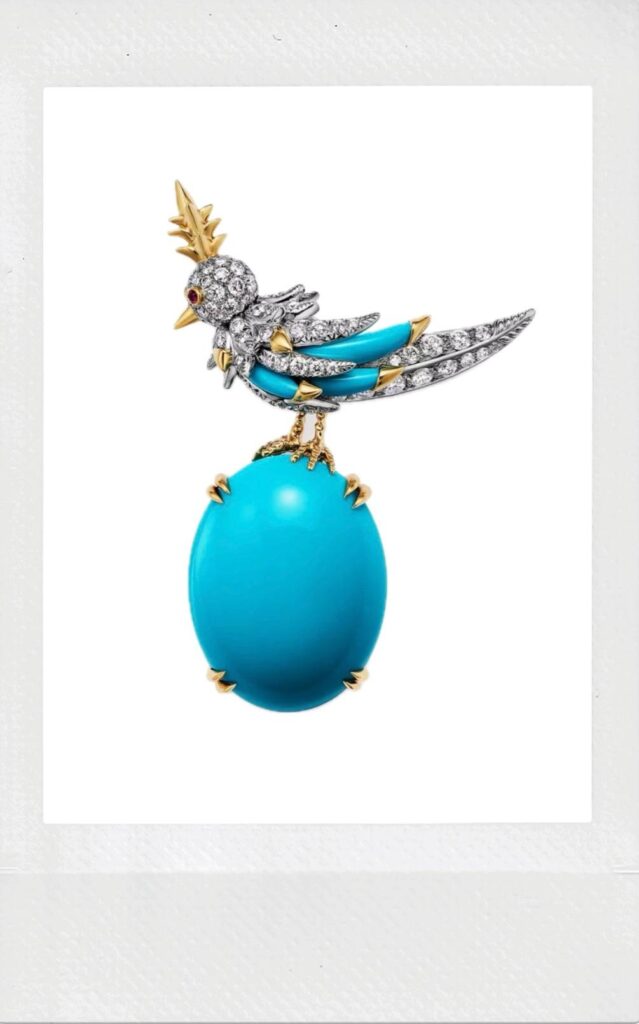
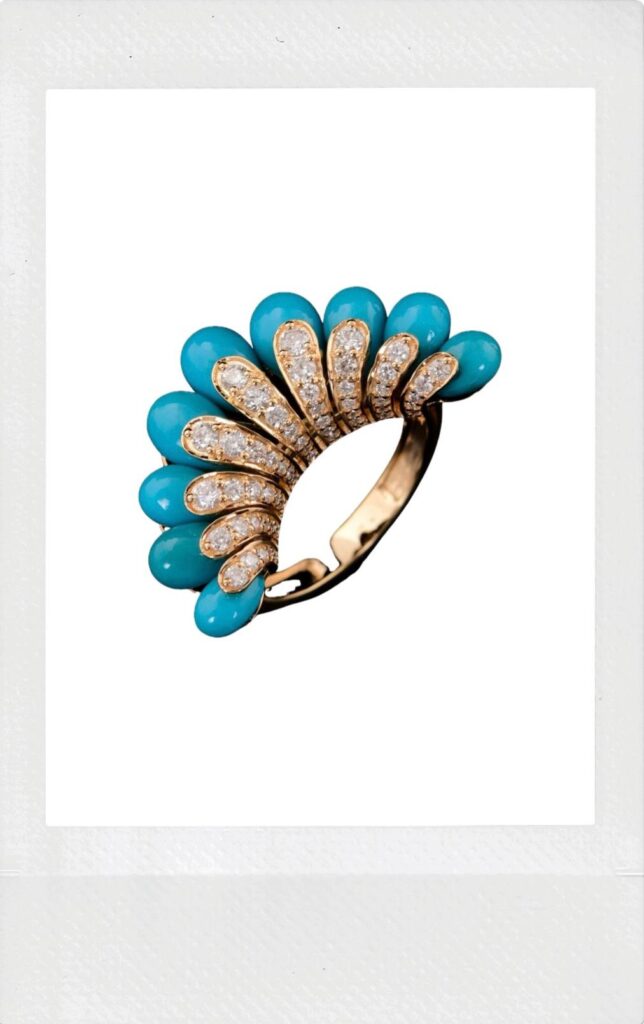
Turquoise behaves differently from traditional gemstones. Because it is matte and visually dominant, it works best as a central surface rather than a secondary highlight.
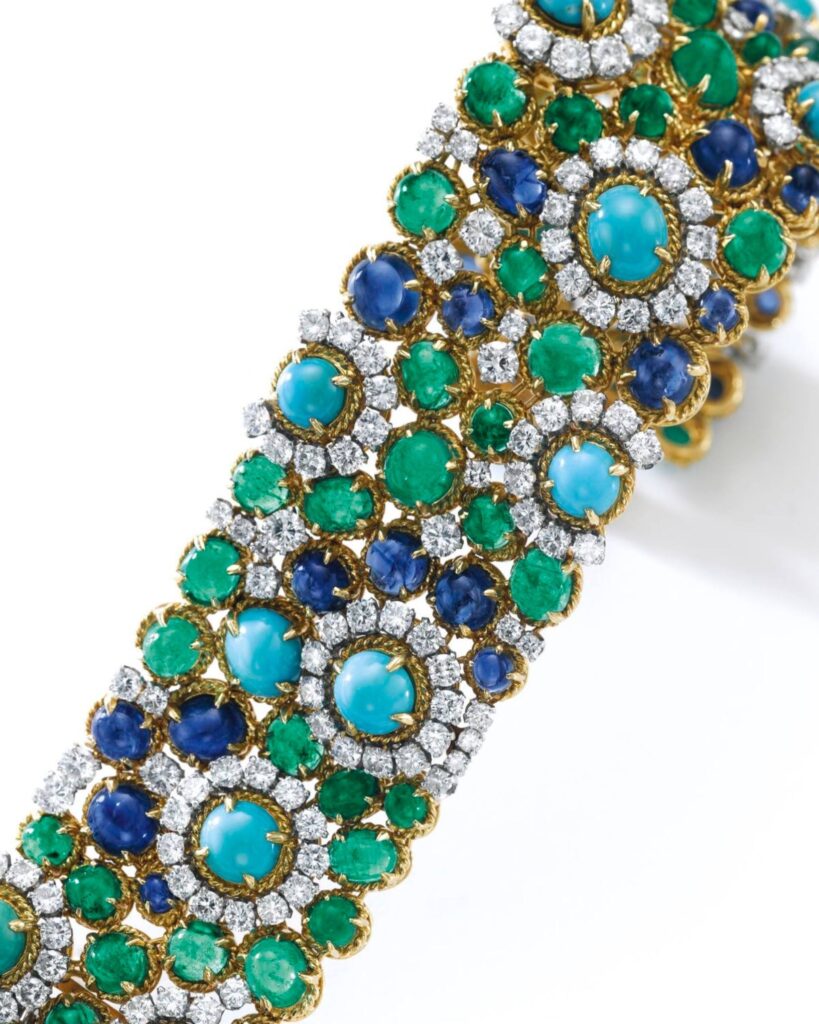
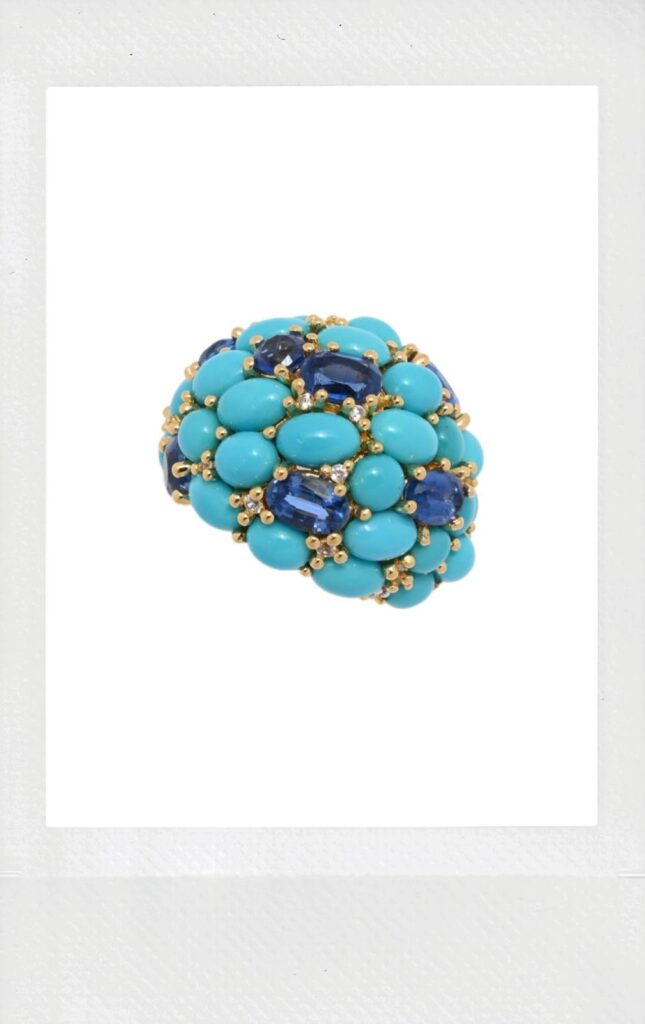
Gold remains its most natural partner. Yellow gold frames turquoise with warmth and structure, stabilizing the stone’s softness while elevating it into fine jewelry. Antique or brushed gold enhances its ancient character.
Silver can also accompany turquoise, though the result is cooler and more graphic. In modern jewelry design, this pairing appears primarily in minimalist or architectural compositions.
Scale also matters. Large turquoise stones should stand alone — a single ring, pendant, or cuff. When multiple turquoise pieces compete within the same look, their authority diminishes.
In terms of wardrobe, turquoise pairs beautifully with natural color palettes: ivory, camel, sand, washed denim, soft browns, and charcoal. Against black garments, the presence of gold often mediates the contrast, allowing the blue to remain luminous.
Turquoise does not rely on sparkle.
It relies on space.
A Jewel That Changed Its Meaning
Few pieces illustrate turquoise’s narrative power more dramatically than the Marie‑Louise Tiara.
Originally created in 1810 as a wedding gift from Napoleon Bonaparte to Empress Marie-Louise, the tiara was first set with seventy-nine Colombian emeralds totaling nearly 700 carats.
In the 1950s, the jewelry house Van Cleef & Arpels acquired the tiara and made a radical decision. The emeralds were removed and sold individually. The tiara was then reset with seventy-nine turquoise cabochons.
What had once symbolized imperial conquest was transformed into an object of cultivated calm.
Later owned by American heiress Marjorie Merriweather Post, the tiara was eventually donated to the Smithsonian Institution, where it remains a testament to turquoise’s unique role in jewelry history.
Turquoise did not intensify authority.
It redefined it.
If it sparks something in you, you already know where it goes: