Why Beautiful Women Still Dress Badly: Beauty vs. Style Explained
Physical beauty and dressing well are two completely different visual skills. Here is how to see the difference, and how to train your eye.
Have you ever seen a strikingly beautiful woman, wearing the best clothes and designer brands, and yet when she walks, something still feels off? Almost as if the clothes are fighting her?
It is not her taste, and it is certainly not her budget. The problem is an assumption most of us make without noticing: that physical beauty automatically means knowing how to dress.
It doesn’t. Those are two completely different things.
Beauty Is Not Visual Intelligence
When someone has a striking face, beautiful hair or an attractive figure, we almost automatically expect the clothes to follow. Yet we have all seen the opposite. A woman can be objectively beautiful, wear expensive clothes, and still look less impressive than the dress itself in a photograph, with nothing extraordinary going wrong.
There is a reason for this. Beauty belongs largely to the person. Style is about relationships between things: the face and the neckline, the shoulder and the jacket, the length of the skirt and the shoe.
What Fashion History Already Knew
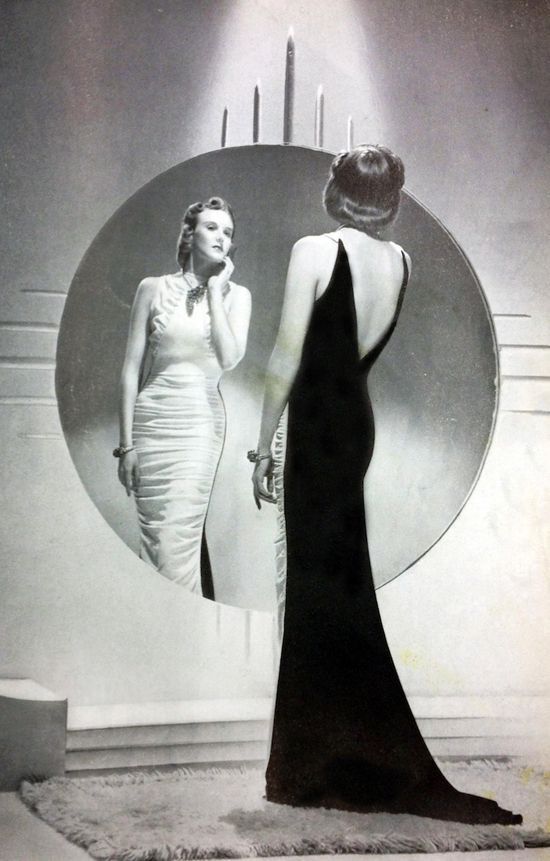
This distinction is not new. Portrait painters and dressmakers of the eighteenth and nineteenth centuries understood it extremely well. Clothing was never simply decoration around a beautiful woman. Necklines, sleeves, hairstyles, jewelry and color were carefully arranged to control where the eye travelled across the figure.
The great fashion houses later mastered the same principle. Balenciaga was famous for thinking architecturally about the relationship between fabric and the body. Christian Dior changed the perception of the female figure through proportion: shoulder, waist, skirt and length were designed as one composition.
That word matters: composition.
The Biggest Dressing Mistake: Choosing Objects Instead of Building a Composition
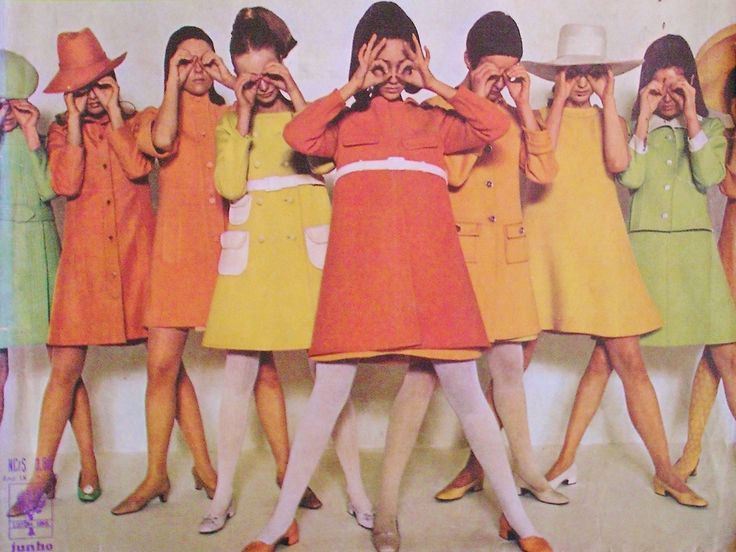
One of the most common mistakes is judging every item individually. You find a beautiful blouse. A beautiful skirt. Shoes you love. Earrings you love. Every decision makes sense on its own, but when everything comes together, the outfit feels strangely wrong.
The problem may not be your taste. The problem is that you selected objects instead of building a composition. And you don’t need any special skill set to fix that.
Think about a room. A beautiful sofa, an extraordinary lamp and an antique table can each be excellent pieces and still look terrible together if their proportions fight each other. Clothing works in exactly the same way.
Why Beauty Can Hide Styling Problems
Beauty can disguise this problem for a long time. An attractive woman receives compliments even when her clothes are doing very little for her. People are responding to her face, her hair or her figure, so she gets less useful feedback about the outfit. She may keep buying pieces that are attractive but have no relationship to her proportions.
Exercise 1: The Full-Length Photo Test
This is where I would start before buying anything new.
Take a full-length photograph of yourself in an outfit you consider successful.
Take another in an outfit that never really works or always feels off.
Don’t ask which clothes are prettier. Look at the entire silhouette as a flat image.
Then look at it in a single glance and ask yourself:
Where does my eye go first?
Does the outfit have one clear focal point, or do the shoes, bag, jewelry and print all demand attention at once?
Does the jacket end at a flattering point on my body?
Does the shoe continue the line of the trouser, or cut it in an unpleasant way?
This is the first practical shift: stop evaluating clothes and start evaluating relationships. A beautiful wardrobe cannot compensate for a badly constructed image.
Visual Hierarchy: Why an Outfit Looks Wrong When Every Piece Is Right
So what makes an outfit look wrong even when every individual piece is right? Very often, the eye has nowhere comfortable to settle.
This is where visual hierarchy becomes useful. Painters, photographers and interior designers work with it constantly: some elements lead the eye, others support them. Clothes work the same way.
Imagine a woman wearing a dramatic printed blouse, large earrings, a contrasting belt, statement shoes and a recognizable handbag. None of these pieces is necessarily a mistake. The problem is that they are all trying to become the most important part of the image.
Now remove two of them, or reduce their visual weight. Suddenly you notice her face. You notice the cut of the blouse. The interesting piece becomes more interesting because it finally has space to register.
The opposite problem exists too. An outfit can be so cautious that nothing defines the woman wearing it. So the solution is not simply fewer accessories or more neutral clothes. A turquoise dress with gold earrings can have an excellent hierarchy. A floral coat over a simple dress can too.
The question is always: what is leading the image?
Exercise 2: Look From a Distance, Then Come Closer
Before leaving home, step back and look at yourself from several metres away, rather than studying every detail in the mirror.
Identify the first thing you notice, then the second.
If your eye goes straight to an awkward trouser break, an oversized bag or a shoe that visually shortens the leg, you have found useful information.
Then come closer and look at the relationship between your clothes and your face.
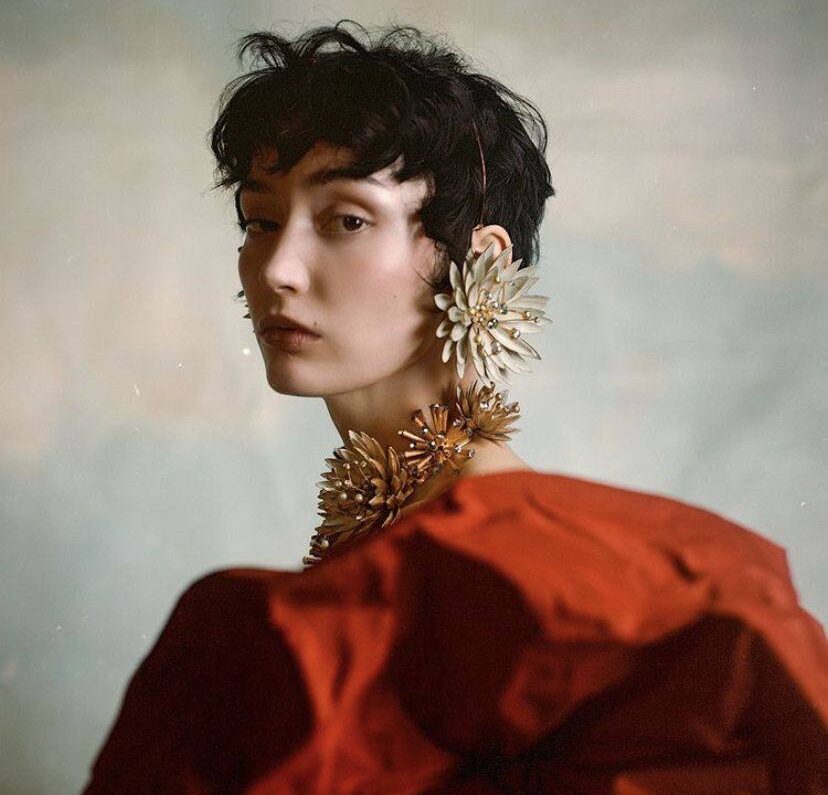
Some women can carry enormous earrings because their features remain present beside them. On another woman, the same earrings arrive before her face does.
Why Copying Someone Else’s Outfit Doesn’t Work
This is also why copying an outfit is unreliable. You can buy the exact same dress, shoes and earrings and get a completely different result, because you changed the person at the center of the composition.
Why Photos Teach You More Than Mirrors
A mirror is familiar. We move, adjust our posture and unconsciously look at the parts of ourselves we already know. A photograph freezes the composition.
Take one photo from the front, one from the side and, occasionally, a short video while walking. You will start noticing things that shopping alone can never teach you, like where fabric collapses, where a line breaks, and where the proportions fight each other.
Do this repeatedly and something important begins to happen: you train your eye.
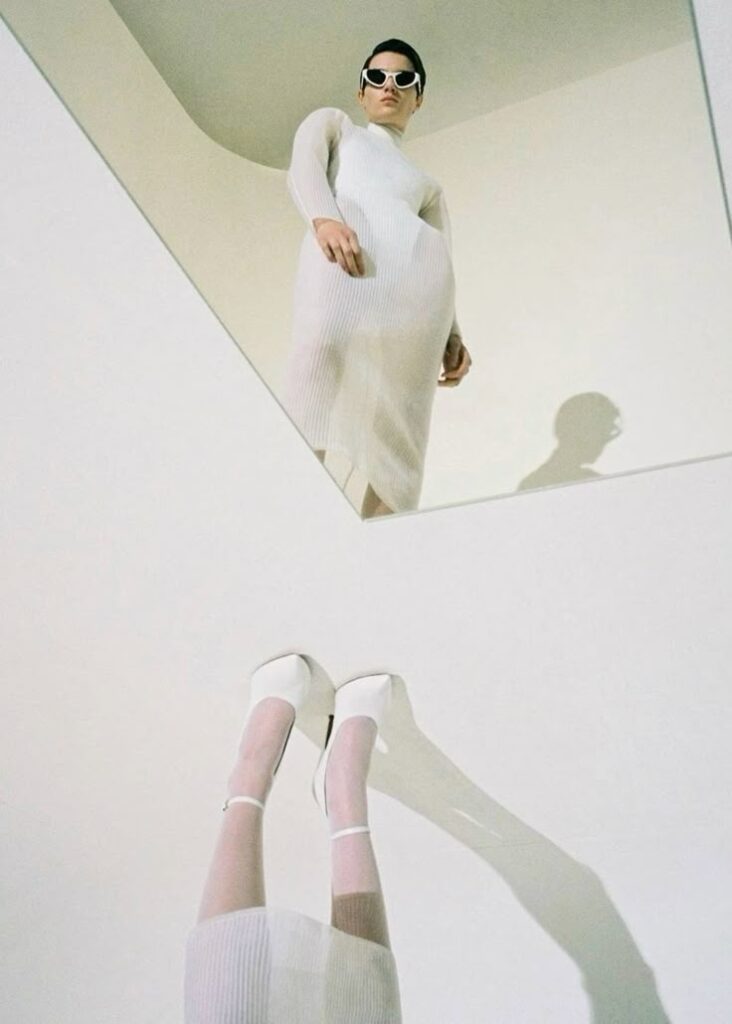
A One-Week Challenge to Develop Your Personal Style
I am not a professional stylist. I’m just like you: I love beauty, and I know very well that taste can be developed. You can study proportion, become more sensitive to color, and learn to recognize beautiful materials. After enough observation, you stop needing twenty rigid rules, because your eye begins catching the problem before you can even name it.
So if you often buy beautiful clothes and still feel disappointed when you get dressed, don’t start with another shopping trip. Try this for one week:
Photograph your outfit every day.
Choose one thing to study each day: proportion, color, scale, focal point or movement.
Change one element and photograph the outfit again.
Compare the two images.
You are building a personal visual vocabulary.
Refining Beauty, Not Decorating It
The sculptor Constantin Brâncuși said that what is real is not the external form, but the essence of things. There is something useful in that idea for personal style. Refining your beauty is not about decorating yourself until there is nothing left to add. It is about learning to see yourself clearly enough to understand which forms, colors and details make your own beauty more precise.
And perhaps that is the real difference between being beautiful and dressing beautifully: one can be given to you; the other is something you learn to see
Want to see this explained in full? Watch the video above, and explore more on style, history and luxury at ClassyByHer.